From just-in-time to just-in-case: TXF Amsterdam 2026

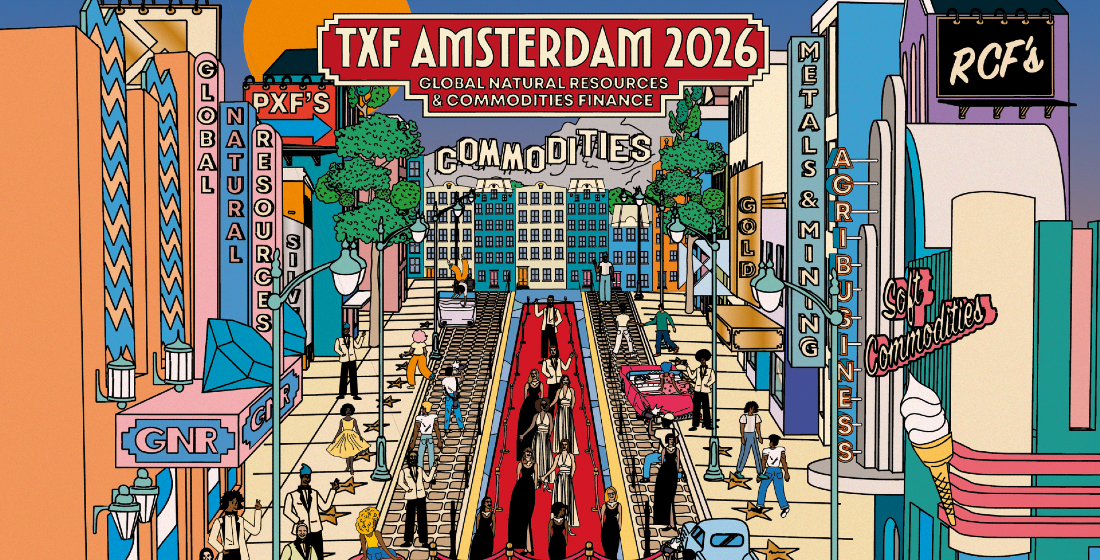
The 2026 edition of TXF’s Global Natural Resources & Commodities Finance event took place this month in Amsterdam. Renewed geopolitical strife brings its challenges but the market is awash with opportunities for banks and traders alike. Going forwards, delegates concurred that supply chains are evolving to prioritise resilience and security.
The global commodities market has emerged from two years of relative calm into a fresh set of geopolitical crises. For all the talk of fragmentation, international trade has proceeded with few blemishes in recent years and tit-for-tat action between the United States and China did not reorient the global economy overnight.
Today, the commodities business is grappling with challenges that materially and immediately threaten the flow of goods. Make no mistake: the ongoing conflict in the Gulf could lead to the most serious energy crisis of the past century. Between the rerouting of physical flows due to armed conflict, the fracturing of geopolitical alliances, and the creeping spectre of global protectionism, the fundamental architecture of cross-border trade has been severely tested.
It was against this backdrop that the market gathered for TXF Amsterdam 2026. Bringing together commodity traders, producers, insurers, and financiers, the event served as a barometer for an industry in turmoil.
The mood on the ground was remarkably energetic. Opportunities are everywhere and it is no secret that trading companies have profited from market disruption. Simultaneously, banks have seen increased utilisation across their facilities as well as demand for emergency buffer loans. It is a testament to a sector that has proved adept at rewiring global supply chains at short notice. Just a few years ago, participants were surprised by the impact of the Russia-Ukraine war and the scramble for financing proved chaotic. This time, experience was at close hand and delegates remarked upon the success of collaboration between banks and their clients.
However, it would be dangerous to mistake this resilience for a return to business as usual. The gravity of ongoing trade disruptions means that liquidity is more important than ever. Time will tell if lenders have the resilience to manage a serious energy shock.
Here are the key takeaways from the ground in Amsterdam.
Just in case, not just in time
The era of lean, hyper-efficient supply chains is dead. Driven by geopolitical shocks and the vulnerability of critical chokepoints like the Strait of Hormuz, traders and producers are shifting to strategic stockpiling. This "just-in-case" model is building vital supply chain resilience, but it is drastically increasing working capital requirements across the board. As one speaker at the event noted: "This is by far the largest energy disruption in history… the financial markets think that there's a giant red switch on a wall somewhere. So we can flip that switch and reopen the Strait. And that is simply not the case."
Security subordinates sustainability
The 'S' in ESG has quietly pivoted to stand for 'Security'. While decarbonisation remains a long-term imperative, the immediate realities of war and supply shortages mean that energy and mineral security are taking absolute precedence. "There is no energy transition without molecules or metals," observed a senior European banker. "Sustainability is not out of the door, but it's clearly subordinated by security."
The price of protectionism
Free trade is rapidly fracturing into regionalised blocs, driven by a desire for a "level playing field." US tariffs and the EU’s Carbon Border Adjustment Mechanism (CBAM) are forcing the regionalisation of supply chains and creating massive price arbitrages. The impact on the physical market is stark. "A hot-rolled coil of steel costs $470 FOB China; the same coil costs $1,000 in the US at the moment, freight included," pointed out one seasoned trader, highlighting the growing divide between protected and unprotected markets.
The flight to size
Commercial banks are providing massive capital scale, but rigorous compliance and sanctions oversight have led to a distinct "flight to size." Portfolios are increasingly concentrated on the top-tier global trading houses. This is creating a dangerous liquidity vacuum for SME and mid-market traders. To bridge this gap, the industry is leaning heavily on export credit agencies (ECAs), development finance institutions (DFIs), and a credit and political risk insurance (CPRI) market that has swelled to $168 billion in capacity.
AI is a tool, not a trader
Artificial intelligence dominated side-bar conversations, largely viewed as a powerful middle-office tool for triaging massive datasets and managing compliance. However, the consensus remains that it is no threat to the core relationship-driven nature of the business. As one banking head noted, commodity trading is about the physical world, and nothing replaces looking a client in the eye to gauge the reality of a transaction.
The TXF Perspective
The discussions in Amsterdam confirm that the commodities finance market is undergoing a structural rewiring, not just weathering a temporary storm. The sheer volume of capital required to fund "just-in-case" inventories and secure critical minerals is staggering, and the market's ability to syndicate this risk is impressive.
The most important source of comfort for the industry is its proven agility in the face of geopolitical volatility. Still, the concentration of liquidity among a handful of mega-traders, and the corresponding squeeze on the mid-market, poses a systemic risk that insurers and alternative credit providers can only partially mitigate. The market is likely to remain highly capital-intensive and increasingly fragmented, requiring careful understanding of regional policies and a very steady nerve.